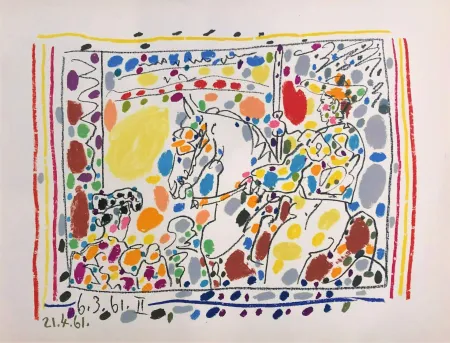
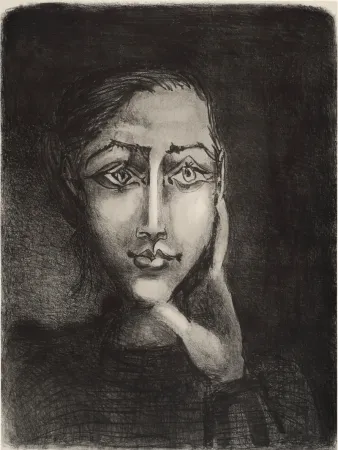
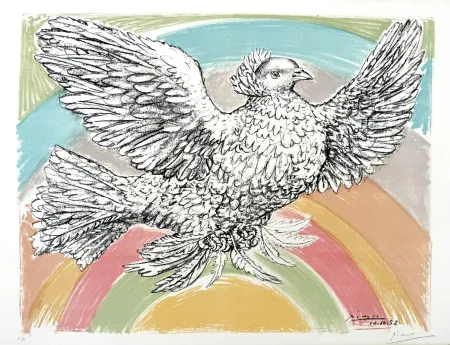
Lithograph from 1969.
The edition: A 246/250.
Dimensions of work: 65.5 x 50 cm.
Plate signed.
Publisher: Éditions Cercle d'Art, Paris.
--
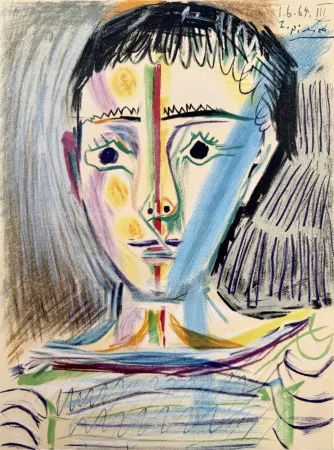
In the early months of 1969, as Pablo Picasso approached his 88th birthday, he embarked on what would become one of the most spontaneous and imaginative series of his career: Portraits Imaginaires. Despite being in the final years of his life, the master showed no signs of slowing down. Instead, he unleashed a flurry of creativity—brilliant, humorous, and deeply expressive—through a series of fantastical faces that exist somewhere between theater, dream, and abstraction.
It all began when Fernand Mourlot, Picasso’s trusted printer and longtime collaborator, visited him at his home in Mougins. Mourlot brought with him sheets of lithographic transfer paper—light, portable surfaces on which Picasso could draw directly with special crayons and inks. Rather than using them for preparatory sketches or carefully planned compositions, Picasso leapt into action. Almost daily over a few weeks, he created image after image, sometimes several in a single sitting. By March, he had completed 29 striking lithographs.
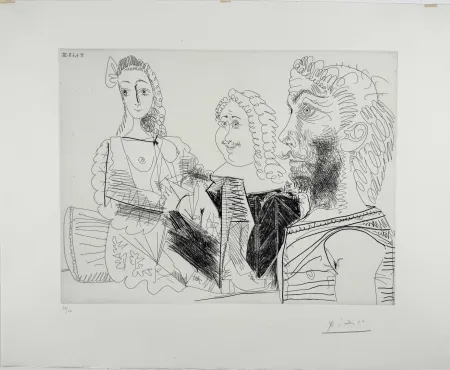
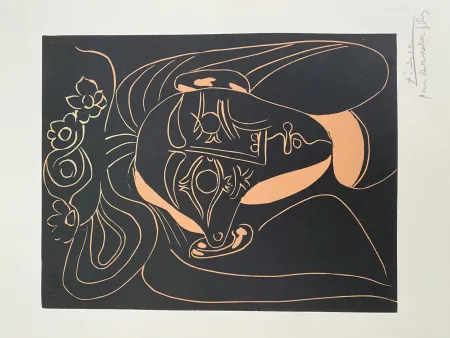
These works were not portraits in the traditional sense. They were invented characters—imaginary visages of jesters, courtiers, tragic actors, and dreamlike creatures—each brimming with personality, wit, and color. They carried the spirit of the Commedia dell’arte, of carnivals and cabarets, of lives imagined rather than lived. The series reflected Picasso’s fascination with masks, with theatricality, and ultimately with the infinite ways a human face could be reimagined..
The work is in Fair condition.